
Forty minutes into a keynote general session at a 600-person conference, the projected image on the main screen goes black. The speaker stops mid-sentence. Six hundred people stare at a blank screen. The conference director is on her radio immediately, looking for an answer.
This scenario happens at events every year. It happens to experienced event planners at well-run venues with equipment from reputable vendors. It is not always preventable — but the outcome is entirely determined by what the rental company has in place before the failure happens, not by what they do after you call to report it.
This guide explains the real causes of mid-event projector failure, the difference between how different rental companies respond, what you can do before your event to reduce the probability and the impact, and the one question that separates projector rental vendors who will solve your problem in twelve minutes from those who will leave you holding an empty stage.
Traditional lamp-based projectors use high-pressure mercury or xenon arc lamps with rated lifespans of 2,000 to 5,000 hours. Within that rated lifespan, lamps can fail without warning — often suddenly, mid-presentation — because lamp failure is not a gradual process. The lamp either produces light or it does not. When it fails, it fails completely and immediately.
The risk of sudden lamp failure increases non-linearly toward the end of a lamp’s rated life. A lamp at 4,800 hours on a 5,000-hour rated lamp has a meaningfully higher failure probability than the same lamp at 2,400 hours. A rental company that does not track lamp hours on its inventory and cannot tell you the lamp hour count on the specific unit being delivered to your event is a company that cannot give you an accurate risk assessment.
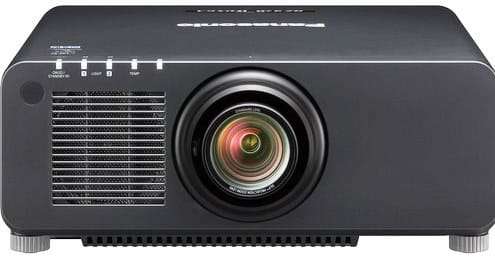
Laser projectors eliminate this failure mode entirely. The Epson L630SU and Panasonic PT-RZ970 use solid-state laser light sources with rated lives of 20,000 hours and no sudden failure mechanism equivalent to lamp burnout. For multi-day high-stakes events, this is the primary operational argument for specifying a laser projector regardless of whether the ambient light conditions require the higher lumen output.
Projectors contain thermal management systems that shut the unit down automatically when internal temperature exceeds safe operating thresholds. This is a designed protective feature. When it triggers during an event, it produces the same result as a lamp failure from the audience’s perspective: a black screen.
Overheating during events is almost always caused by improper setup — the projector is placed in a position that restricts airflow to its intake and exhaust vents. Common causes include: the projector placed inside an AV cart enclosure without ventilation clearance, the projector positioned against a draped surface that blocks the exhaust, or the projector in a high-ambient-temperature environment such as a hot exhibit hall without air conditioning.
A technician who sets up a projector correctly checks airflow clearance before leaving the room. A rental company that drop-ships equipment without a setup technician cannot check this. The distinction between attended and unattended delivery is a meaningful operational risk variable.
Many apparent projector failures are not projector failures at all. They are signal path failures — a loose HDMI connection, a failing HDMI cable, a laptop that has switched display output mode, or a switcher/splitter in the signal chain that has lost signal or frozen. The projector is functioning correctly; it is simply receiving no signal to display.
Signal path failures are the most rapidly diagnosable and fixable category of mid-event AV problem — if there is a technician in the room. Without a technician, the presenter or event staff must troubleshoot an unfamiliar signal chain under time pressure in front of an audience, which compounds the problem in both duration and visible disruption.
Connectivity failures account for an estimated 40 to 60 percent of reported “projector failures” at events where signal chain troubleshooting data is collected. The majority resolve within three to five minutes with an experienced technician present.
Convention centers and hotel ballrooms operate on commercial electrical systems that are generally stable. However, in large exhibit halls with thousands of exhibitors sharing power distribution infrastructure, voltage fluctuations and brief power interruptions occur more frequently than in controlled office environments. A projector without a UPS (Uninterruptible Power Supply) in the signal chain will reset completely on any power interruption, including sub-second fluctuations.
The recovery time from a power-related reset on a lamp projector — including lamp warmup — can range from 90 seconds to four minutes depending on the model. A laser projector recovers from a power reset in under 10 seconds due to instant-on laser technology. For events in large exhibit hall environments, this difference in recovery time is operationally meaningful.
Modern projectors auto-detect the resolution and refresh rate of the connected source device. When a presenter connects their laptop to the projector using a new HDMI connection and the laptop outputs a resolution or refresh rate the projector cannot process, the result is a black screen — or in some cases, a flickering or distorted image — that is indistinguishable to observers from a hardware failure.
This is the AV failure mode most commonly experienced by presenters using Mac laptops, which can output display resolutions and color profiles that require explicit compatibility configuration on the projector side. A pre-show check — running the presentation from the actual laptop through the actual signal chain before the session begins — eliminates this failure mode entirely.
Failure cause | Visible symptom | Time to fix with technician | Fixable without technician? | Prevention |
Lamp failure | Sudden complete black screen | 10–30 min (replacement unit) | No | Specify laser projector |
Overheating | Black screen after 20–40 min runtime | 5–15 min (cooldown + reposition) | Possibly | Check airflow at setup |
Connectivity / cable failure | Black screen or no-signal message | 2–5 min | Possible but stressful | Pre-show signal check |
Power interruption | Reset and reboot (lamp: 2–4 min; laser: <10 sec) | Auto recovery | Yes (laser much faster) | UPS on power circuit |
Display mode conflict | Black screen or distorted image on new connection | 3–8 min | Possible with tech-literate presenter | Run presenter laptop at setup |
The response to a mid-event projector failure differs dramatically between rental companies. Understanding that difference before you choose a vendor is more valuable than any review or testimonial.
The vendor delivers equipment by freight and provides a phone number for technical support. When the projector fails, you call the number. A support technician walks you through troubleshooting steps by phone — checking cables, cycling power, confirming display mode settings. For connectivity and display mode failures, this may resolve the issue in 10 to 20 minutes.
For lamp failure, overheating, or hardware failure, remote support cannot fix the problem. The phone technician will confirm the unit needs replacement and initiate shipping of a replacement unit — which, depending on your location and the vendor’s nearest inventory, may arrive the same day, the next morning, or the next business day.
If your conference is a three-day trade show in Las Vegas and the projector fails on day one morning, “next business day replacement” is not a solution. The general session runs without a screen for the remainder of day one.
A technician delivers, sets up, and tests the equipment, then departs. Phone support is available throughout the event. This resolves connectivity and display mode failures faster than remote-only support because the technician who set up the system has direct knowledge of the signal chain and can diagnose more rapidly by phone.
For hardware failures requiring a replacement unit, the response time depends on the vendor’s proximity to the event venue and their local inventory. A vendor with a warehouse 45 minutes from McCormick Place can dispatch a replacement unit within 90 minutes of a confirmed hardware failure. A vendor shipping from a national distribution center may take hours or overnight.
A technician remains on-site at the event venue for the full duration of the rental. Signal path failures are detected and resolved in real time — often before the speaker has finished their sentence. Connectivity issues, display mode conflicts, and overheating are caught and corrected before the audience sees a failure. Hardware failures trigger immediate escalation to local replacement inventory.
On-site technician coverage is the most comprehensive protection available for high-stakes events: keynote general sessions, multi-day pharmaceutical conferences with regulatory-sensitive presentations, investor summits, and events where a visible AV failure has reputational consequences beyond the immediate inconvenience.
The question to ask every vendor before you book “If the projector produces a black screen thirty minutes into my keynote session, what specifically happens next, and what is your realistic timeline to restored image on screen?” The answer tells you everything about the vendor’s operational capability. A vendor who cannot give a specific, credible answer to this question is a vendor whose support capability has not been thought through. |
The majority of mid-event projector failures are preventable. The following checklist represents the pre-event verification steps Aria AV technicians perform on every setup before handing the system over to the client.
The Panasonic PT-RZ970 10,000-lumen Solid Shine Laser and the Epson PowerLite L630SU 6000-lumen Laser 3LCD eliminate the single most common and least predictable failure mode: sudden lamp burnout. Beyond eliminating lamp failure risk, laser projectors provide three additional operational advantages for event resilience:
Instant recovery from power interruption: A laser projector recovers from a power reset in under 10 seconds. A lamp projector takes 90 seconds to four minutes to warm up a new arc. In a live event environment, the difference between a 10-second and a 3-minute outage is the difference between a barely-noticed blip and a visible disruption that gets written into the post-event summary.
Consistent brightness across multi-day events: A laser projector on hour eight of day three of a trade show performs at the same brightness as it did on hour one of day one. A lamp projector at the same point in runtime may be operating at 70 to 80 percent of its original brightness output — less visible to anyone watching a given session in isolation, but cumulative in impact across a long event program.
Dual-module failover on the PT-RZ970: The Panasonic PT-RZ970 uses two independent laser modules. If one module is reduced or fails, the second module maintains operation at reduced but functional brightness. This hardware-level redundancy has no equivalent in lamp-based projector technology. For a 10,000-lumen keynote general session projector, dual-module protection is the closest available equivalent to true projector redundancy without running a full hot-standby backup unit.
For the highest-stakes presentations — a 600-person investor conference keynote, the opening general session of a pharmaceutical symposium, a product launch with broadcast media present — a backup projector unit staged in the room is the most complete protection available. A backup unit is positioned and cabled but not powered; it can be switched live within 60 to 90 seconds of a primary unit failure.
Aria AV provides backup unit staging as an add-on for any event. The cost of a staged backup projector is a small fraction of the cost of a visible failure in front of a full conference audience. For events where the reputational or relationship consequences of an AV failure are significant, backup unit staging is the correct specification.
Aria AV’s commitment on every event If a projector we deliver fails to perform to specification during your event, we dispatch a replacement unit immediately from the nearest local inventory. For Las Vegas and Chicago events, that means local warehouse dispatch within 90 minutes of a confirmed hardware failure. For events in other cities, we work with our national network to reach the fastest possible resolution. Every rental agreement includes this commitment. Ask us about on-site technician coverage and backup unit staging when you request your quote at ariaav.com/request-a-quote/ or call 866-840-1472. |